Although marketers have realized mobile’s potential to boost a campaign’s overall ROI, most marketers are still leaving ROI increase potential on the table by under-allocating to mobile. Exactly how do you leverage and optimize mobile in your cross-media campaign?
First, consider increasing your mobile allocation to double digits. Findings from Mobile Marketing Association’s Smart Mobile Cross Marketing Effectiveness (SMoX) study, which shares learnings from The Coca-Cola Company, Walmart, MasterCard and AT&T campaigns, demonstrate that the optimal allocation for mobile is in the double digits.
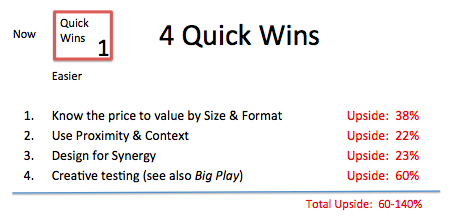
Another component to increasing mobile's ROI is to get the “right message to the right person at the right time, at the right price”. Apply these 4 mobile quick wins, the practical recommendations that can be applied immediately and with relative ease, to your campaign to improve your mobile ROI by 60% to 140%.
The four “take it to the bank” quick wins on how to successfully use Mobile advertising are:
- Optimize the price to value by size & format to get more ROI
- Use proximity & context to boost ROI
- Design for synergy
- A/B Split test to increase creative impact
Let’s break these down quickly:
We know that there is a relationship between larger ad formats and increased impact. However, the most important piece in this relationship is the relative cost. Is the cost of a larger or more engaging ad format worth it? Our findings vary by ad type.
- Mobile display ad banner is a good awareness builder and reminder, keeping a brand salient
- Audio and video had greater influence on brand perceptions and sales
- A mix is likely to generate better results than investing the entire budget in a single format.
The key is to think in terms of a mix of formats. We found that different ad formats had different types of impact, and applying the format mix optimization can increase the overall ROI by 38%
Mobile is special because people carry it with them all day. This creates opportunities for context targeting by time of day and by location.
A feature of mobile optimization is the ability to examine the influence of advertising delivery on foot traffic to a store location. For example, Walmart can deliver messages to consumers who have visited the retailer in the past, and target them wherever they might be; the industry calls this “Re-targeting.” Even more powerful than re-targeting is proximity targeting, delivering the message when the consumer is “in range” of Walmart.
In general, proximity targeting works better than re-targeting, with the strongest impact coming from the combination of larger ad unit and proximity targeting.
Coca-Cola applied the powerful “surround sound” strategy, where messaging and creative cues looked similar across all media, which resulted 23% higher impact because synergies among multiple media.
Consumers often use their smartphone while consuming other media; using creative cues across advertising platforms to reinforced the message. There are no costs in achieving message synergies; “surround sound” strategy is a high value approach that too few marketers take advantage of today.
When marketers only use one creative message in Mobile, the marketer misses a great opportunity to learn how different messages work for different audiences in mobile and optimize the creative rotation accordingly. There are a couple benefits to A/B split testing, namely: